
CiD
The Innovation Alliance Circular Design (CiD) offers a radically new model on how to link design to circularity and urban transformation. The Alliance aims to establish benchmarks for rethinking design in a circular economy, shifting urban design, architecture, product and service design towards carbon-neutral cities, and enhancing bio-based innovation for building.
How to change architecture, urban design, product/service design through the impulse of circular economy, bio-innovation, and urban transformation?
CiD
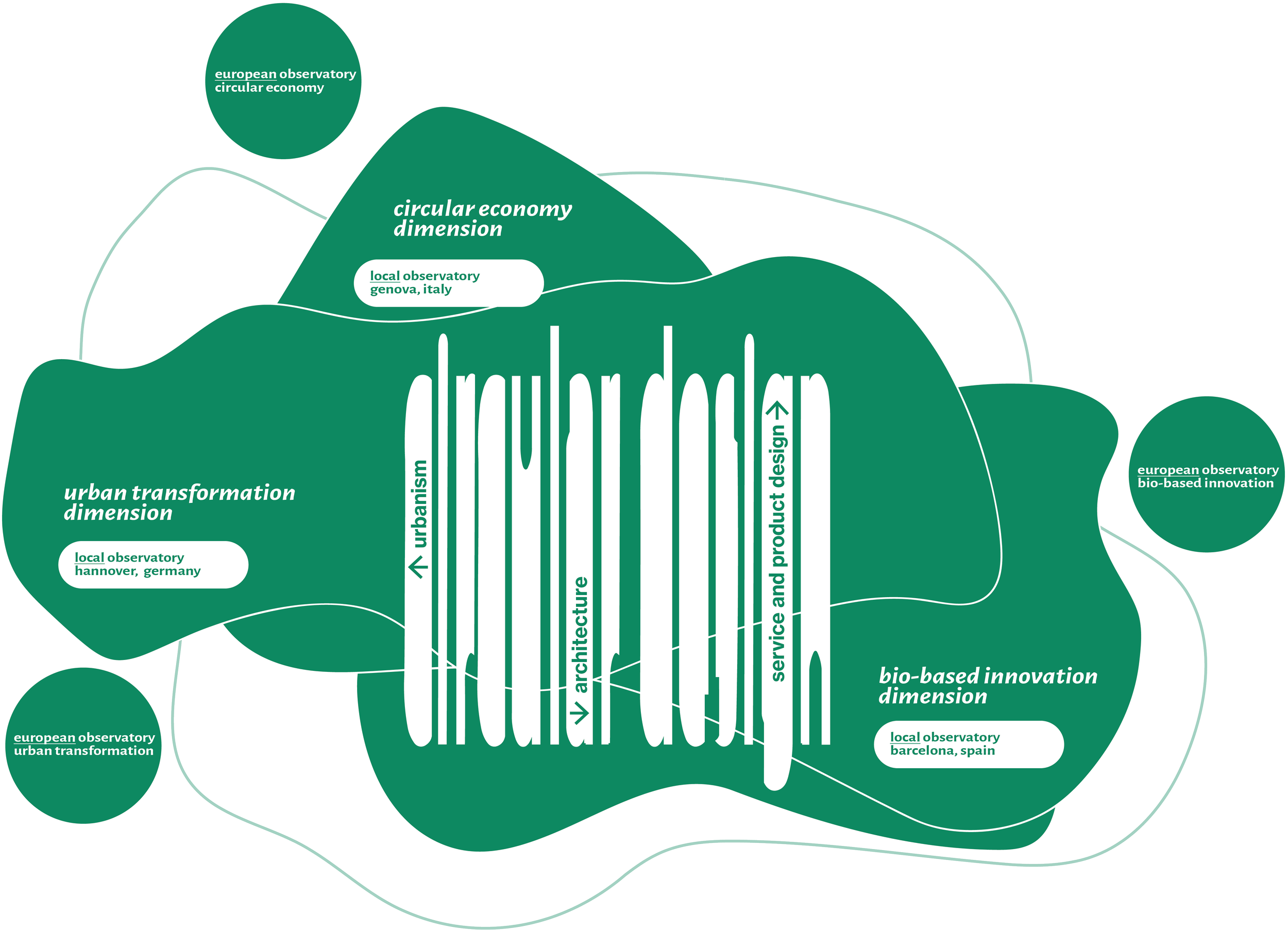
Key themes are a new vision of design in circular economy, circular design for urban transformation towards climate neutrality, and bio-innovation to build and renovate. In the innovation ecosystem CiD sets up, 6 Observatories with relevant stakeholder are inspired by the work of the Observatories will be inspired by social, cultural, ecological and economic sustainability principles to connect education and research with society and enterprises.
Objectives
(1) the co-creation of multidisplinary knowledge on circular design, (2) the set-up of an innovation ecosystem for circular design together with 6 observatories to connect education and research with society and enterprises, (3) educational innovation with three teaching and learning programmes (academic, accelerator, continuous education), (4) stimulating entrepreneurship and the creation of green start-ups, (5) closing the gap regarding green, resilience, and digital skills in and between architecture, urban design, product/service design.
sustainability roadmap
The CiD Sustainability Roadmap sets out the framework to ensure that the project’s results, partnerships, and educational model continue to generate value beyond the funding period. Its core objective is to support the transferability and replicability of CiD educational programmes across higher education (HEI) and vocational education and training (VET) contexts in Europe, while enabling the continuation and further development of the CiD Innovation Ecosystem.
-
The roadmap identifies the key results to be sustained, the conditions required for their continuation, the actors involved, and the mechanisms needed to secure long-term sustainability. It also provides a basis for identifying potential adopters, analysing comparable educational offers, and designing engagement and guidance strategies to facilitate transfer of the CiD model, functioning both as a continuation tool and a transfer tool.
Sustainability is directly linked to CiD’s broader mission of advancing Circular Design as a driver of climate-neutral cities, supporting the green and digital transitions, and fostering innovation through transdisciplinary education and collaboration. The roadmap therefore enhances the long-term visibility, adaptability, and uptake of CiD methodologies, curricula, stakeholder networks, and collaborative practices.
Adopting a systemic perspective, the roadmap connects institutional, ecosystem, and policy dimensions, supporting the embedding of results within partner organisations and education systems, the consolidation of cooperation frameworks, and alignment with relevant European, national, and regional policies.
Accordingly, the roadmap provides:
a framework for the continuation of key results;
governance and partnership mechanisms;
transferability guidance for HEI and VET replication;
a risk analysis with mitigation strategies.
-
The methodological approach underpinning the Sustainability Roadmap is structured around five interrelated components:
Strategic benchmarking of educational practices
Analysis of comparable academic, continuous education, and start-up acceleration programmes to identify best practices aligned with CiD objectives in circular design, sustainable urban transformation, and innovation-driven education.
Stakeholder identification and engagement
Systematic mapping and continuous involvement of key stakeholders to ensure sustained support, foster ownership, and identify potential adopters and replicators of the CiD model.
Validation of programme outputs and performance
Assessment of educational programmes, accelerator activities, and student outputs through defined Key Performance Indicators (KPIs), expert review processes, and partner consultation.
Mapping of outcomes to be sustained
Identification and prioritisation of key results, outputs, and assets that require continuation beyond the project lifecycle.
Definition of continuation mechanisms and governance structures
Development of operational, organisational, and partnership frameworks to ensure the long-term implementation, maintenance, and scaling of CiD results.
-
CiD's long-term vision is to contribute to the transformation of European cities towards climate neutrality, leveraging innovative design practices for a green and resilient urban transition. Through a multidisciplinary approach, CiD addresses existing skills and knowledge gaps in architecture, urban design, and product and service design, offering an educational model that links design with circularity and urban transformation.
The project also contributes to the New European Bauhaus initiative by combining creativity, arts, and technology in support of the Green Deal, while placing strong emphasis on fostering entrepreneurship in academia, supporting the creation of green enterprises, and strengthening skills aligned with emerging labour market profiles.
A key strategic insight from the project is that the practices it promotes are still emerging and not yet fully established in the market. Part of CiD’s legacy therefore lies not only in responding to existing demand but in actively helping to create it, shaping the frameworks and conditions that will govern sustainable design markets. This positions policy advocacy and ecosystem-building as preconditions for, rather than a consequence of, the economic sustainability of project results.
Workpackages
-
-
Workpackage 3 is led by University of Genova based in Genova, Italy.
-
Workpackage 4 is led Tallinn Business Incubator based in Tallinn, Estonia.
-
Workpackage 5 is led by ARCES Association based in Palermo, Italy.
-
Workpackage 6 is led by ALDA Association for Local Democracy based in Vicenza, Italy.
-
Workpackage 7 is led by Leibniz University Hannover based in Hannover, Germany.
features
The CiD Observatory ecosystem is built on a multi-level cooperation designed to ensure relevance, inclusiveness, and long-term impact.
-
The ecosystem brings together academia, vocational education and training (VET), public authorities, businesses, entrepreneurs, researchers, and civil society organisations, creating an environment where diverse perspectives contribute to educational innovation and circular design.
-
The ecosystem combines three local observatories with three European thematic observatories. This structure links local challenges with European priorities while enabling cooperation across territories.
-
In addition to local activities, regular online observatory meetings created a shared space for dialogue among all observatories, facilitating cross-border knowledge exchange, peer learning, and collaboration between local and European stakeholders.
-
The ecosystem connects education with real societal and market needs by embedding stakeholders directly into the learning process and promoting continuous interaction between learners and practitioners.
-
Continuous stakeholder engagement throughout the project allowed the ecosystem to respond to emerging needs and evolving developments in circular design, ensuring that project activities remained relevant and responsive.
-
The ecosystem is designed to extend beyond the project's duration by fostering lasting relationships among organisations, encouraging cooperation agreements, expanding stakeholder networks, and supporting the transfer and uptake of CiD methodologies in future initiatives.