
research
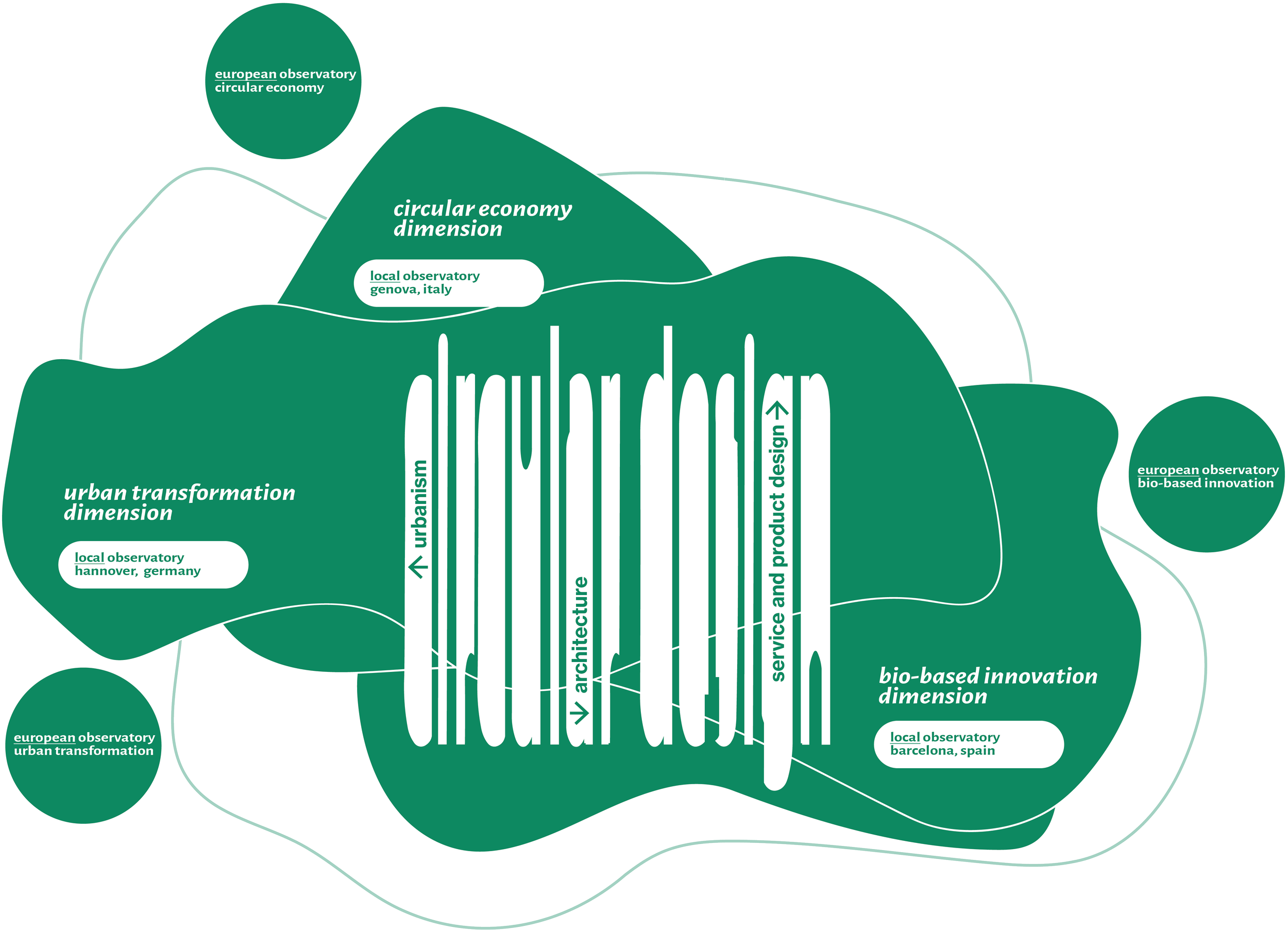
CiD is organised around three research and innovation dimensions: (1) to orient circular design towards carbon-neutral cities, (2) bio-based innovation for buildings, and (3) to rethink design for a circular economy. For the co-creation of knowledge in these transversal dimensions, CiD bring together research, education, and the broader socio-economic environment at local and European level in a multi-actor approach and interdisciplinary approach
Research through three transversal dimensions

coordinated by Leibniz University Hannover, Architektūros Fondas, Ersilia Foundation, Architects' Council of Europe
coordinated by Institute of Advanced Architecture of Catalonia, Materiom Ltd., Consiglio Nazionale delle Ricerche
coordinated by University of Genova and Tallinn Business Incubators

challenges
The identification of circular design challenges provided the basis for developing the research content and shaping the educational programme. It also formed the foundation for the Challenge-Based Learning approach used in the projects and marked the starting point of the CiD Observatory activities.
Each CiD Partner, together with the six Observatories, identified a set of challenges within its thematic or regional context. These were presented during the Knowledge Exchange Workshop, where partners jointly reviewed, refined, and brought the findings together into a shared framework.
Challenges defined within the local observatories of Hannover, Barcelona and Genova:
-
Transform neighbourhoods into hubs of circular economy through co-creation, shared resources, and community participation.
Key barriers: balancing sharing with privacy and property rights, lack of funding for shared infrastructure, rigid planning regulations, absence of incentives for shared spaces and mobility, and limited expertise in designing circular neighbourhoods.
-
Develop flexible, sustainable, and affordable housing models that respond to climate change, demographic shifts, and changing lifestyles.
Key barriers: resistance to new housing models, insufficient public investment, outdated regulations and family-oriented housing policies, slow adaptation of planning laws, and lack of interdisciplinary knowledge for climate-friendly urban development.
-
promote the reuse, refurbishment, repair and retrofitting and infrastructure to reduce waste, Co2 emissions, and resources consumption.
Key Barriers: Higher costs of reuse compared to new construction, complex regulatory frameworks, limited policy support, cultural resistance to reuse and the need for new construction materials and methods that preserve embodied carbon.
-
Integrate circular principles and embodied energy into the lifecycle of buildings to create more sustainable urban energy systems.
Key barriers: fragmented regulations, lack of funding and incentives, insufficient recognition of embodied energy, planning frameworks unsuited to local energy systems, unclear governance of energy communities, and limited management and communication skills for implementing circular energy concepts.
-
Facade systems that can adapt to the climatic conditions & bio-inspired facades
-
Carbon negative materials such as biochar, cork etc.
-
Digital Twins that monitor material flows, material performance, or material passports
-
Adaptation & Mitigation strategies through architecture.
-
Transforming linear supply chains into circular systems that reduce waste generation through improved resource management, recycling, and product life cycle design.
Key Barriers: limited recycling infrastructure, high investment needs for digital and logistics systems, insufficient policy incentives, low adoption of traceability technologies, and regulatory gaps in reverse logistics and circular value chains.
-
Transitioning from single-use plastics to reusable, recyclable, and bio-based packaging solutions in line with European packaging regulations.
Key barriers: limited reuse and recycling infrastructure, high costs of bioplastics, technological performance gaps, investment needs for new production systems, limited bioplastic supply, and regulatory and land-use constraints.
-
Improving public and market acceptance of bio-based materials through clear communication, education, and user-centred narratives.
Key barriers: low consumer awareness, technical and fragmented communication, misconceptions about bio-based and recycled materials, knowledge gaps among businesses, and negative perceptions of aesthetics and product quality.
-
Extending the lifespan of furniture through repair, refurbishment, reuse, and the integration of certified bio-based materials.
Key barriers: limited certification of bio-based materials, regulatory challenges, high research and development costs, and consumer concerns about the durability and quality of bio-based furniture.
European-wide challenges:
-
Shifting from resource-intensive transport to circular, equitable mobility systems.
Key barriers: high infrastructure costs, policy resistance, entrenched car-use habits.
-
Retrofitting and redesigning infrastructure to withstand climate impacts.
Key barriers: inconsistent regional/national regulation, limited public awareness, short-term economic decision-making.
-
Reintroducing nature into cities and improving urban metabolism.
Key barriers: funding constraints, fear of community displacement, cultural resistance to new designs.
-
A community hub combining top-down and bottom-up circular design.
Key barriers: cost accessibility, cultural sensitivity, renewable energy integration.
-
replacing conventional materials with renewable, low carbon alternatives to reduce environmental impacts and improve resource efficiency.
Key Barriers: limited certification, regulatory support uncertainty, funding gaps for innovation, and insufficient technical expertise.
-
Advancing engineered wood products and modular construction techniques to increase the use of wood as a sustainable, resource-efficient building material.
Key barriers: policy and certification gaps, limited funding, cultural resistance to wood adoption, low industry engagement, and shortages of technical expertise.
-
transforming food waste and by-products into valuable materials, services and circular economy solutions.
Key barriers: low consumer awareness, weak supply-chain regulation, lack of biodegradability standards, business resistance to new production models, limited knowledge transfer, and environmental challenges linked to waste recovery and reuse.
-
Strengthening collaboration across government, industry, and local communities to improve bio-waste management and support circular economy objectives.
Key barriers:fragmented regulations, limited commercialisation of research, high infrastructure and investment costs, lack of technical expertise, environmental and land-use concerns, and insufficient stakeholder and consumer engagement.
-
Cutting carbon emissions, minimising lifecycle energy use, and building a sustainable materials supply chain.
Key barriers: limited material availability, high certification costs, regulatory complexity, cultural resistance to change.
-
Driving wider adoption of green roofs on existing buildings.
Key barriers: absence of supportive building codes/incentives, structural retrofit limitations, low public awareness.
-
Improving the reliability of lifecycle environmental impact data.
Key barriers: high resource cost of LCA studies, reliance on specialised expertise, weak cross-supply-chain collaboration
-
Protecting and expanding urban natural ecosystems to counter biodiversity loss driven by urban development, pollution, and climate change.
Key barriers: Habitat fragmentation from urban expansion, biodiversity absent from planning regulation, low community awareness, pollution, urban heat islands and climate-related extreme weather events.
skills
The identification of skills needs was a key step in ensuring that the CiD educational programmes addressed the competencies needed to support the transition towards circular design and climate-neutral cities. It built on the challenges identified by the observatories and provided a basis for defining the skills needed by future professionals.
A common methodology provided a shared framework for identifying and categorising these competencies. Stakeholders contributed by identifying the knowledge and skills they considered most relevant for future practice. To ensure consistency across the project, all identified skills were grouped into four competence areas: Green Skills, Resilience Skills, Digital Skills, and Entrepreneurial Skills

Green skills
Collaboration between social & technical partners
transversal skills developed across all programmes
Resilience Skills
Collaboration between social & technical partners
Digital skills
Visualising Data, Socio-technical expertise
Entrepreneurial skills
Creativity, Leadership
specific skills / academic programme
-
Life cycle assessment, Impact measurement, Global Warming Potential, Biomaterial Knowledge, How to direct Bio-Innovation towards Circular Design
-
Futures thinking, Ethical Recovery, System Thinking, Reinvention Adaptability, Governance & Management, Risk assessment.
-
Data Management, Digital Fabrication, Unconventional Data, Data Analytics & Mapping, AI software knowledge, Digital product passport
-
Cultural Intelligence
specific skills / accelerator programme
-
How to direct bio-innovation towards circular design
-
Governance & Management, Risk assessment
-
Digital product passport
-
Collaboration with experts, Circular business model, Entrepreneurial mindset, upscaling, set KPIs
specific skills /continuous education programme
-
Bio-Materials, Environmental Literacy
-
Political Agency
-
Digital Fabrication, Data analytics & Mapping
-
Cultural Intelligence, Entrepreneurial mindset, set KPIs