
19 - 21 march
Vilnius
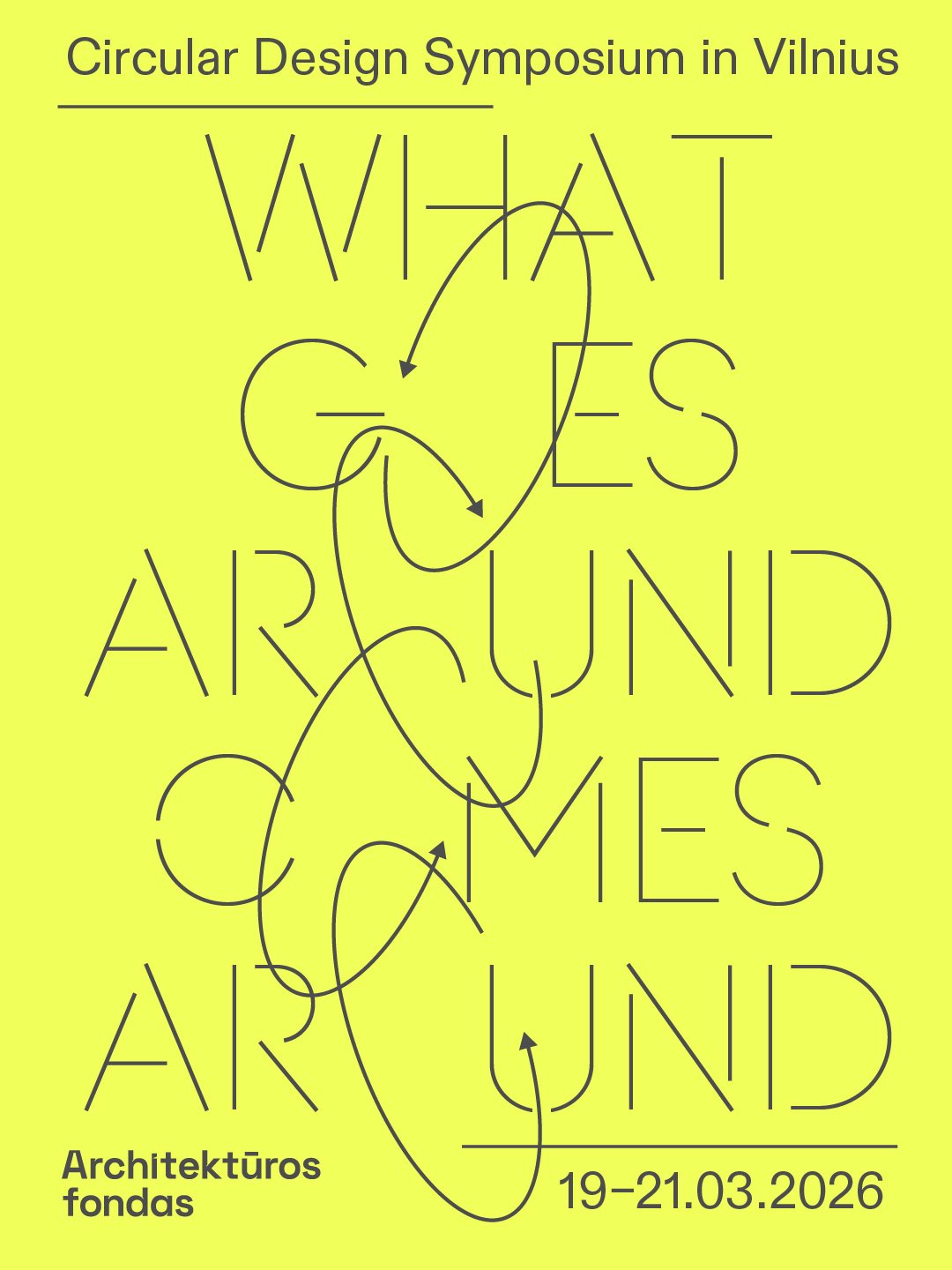
Circular Design Symposium: ‘What Goes Around Comes Around’
This March, the symposium What Goes Around Comes Around will unfold in Vilnius as a three-day constellation of a conference and an art programme. Bringing critical discourse in urbanism and architecture into dialogue with artistic work, the symposium approaches circular design not merely as a strategy of material reuse, but as a profound way of rethinking value, labour, energy, and continuity across time
Organised by Architektūros fondas
Location: National Gallery of Art, Vilnius
All symposium events are free, but some require registration
Programme
-
13:30 / Workshop and discussion
How Continuous Education Can Enable Circular Construction19:00 / Performative walking tour
Hello Darkness(es)
Start: Vitebsko St. 23, VilniusThe tour will be led by interdisciplinary spatial practitioner and researcher Pablo Encinas Alonso.
-
9:30 / Arrivals
10:00 / Opening Keynote
Baukultur and the emerging culture of a social and ecological transitionSpeaker: Italian architect and urbanist Paola Viganò.
11:10 / Coffee break
11:30 / Session 1
Planning for Long-Term TransformationSpeakers and panelists:
Nicholas Duxbury Ransome – Managing Director at Lendager: a circular architecture firm based in Copenhagen;
Kristiaan Borret – quality supervisor of urban transformation areas in the City of Amsterdam and professor of urban design at Ghent University, former Chief Architect (Bouwmeester) of the Brussels-Capital Region; Kateryna Lopatiuk – Ukrainian architect and spatial researcher living and working in Paris.Moderator: Paulius Kliučininkas.
13:00 / Lunch break
14:30 / Session 2
Matters of TimeSpeakers and panelists:
Fabian Lauener – Architect at TEN studio, a hybrid architecture studio based in Zurich and Belgrade;
Alice Babini – Architect at Babini Geysen Architects, whose practice focuses on building transformation, circular design, and material reuse;
Jakob Rabe – Architect at Pihlmann Architects;
Varvara Yagnysheva – Researcher and architect at CO-HATY, contributing to the restoration and reconstruction of housing in Ukraine.Moderator: Martynas Germanavičius.
16:30 / Coffee break
17:00 / Closing Keynote
Speaker: Artistic and Managing Director of the International Architecture Biennale Rotterdam (IABR) Saskia van Stein.
-
National Gallery of Art, Konstitucijos Av. 22, Vilnius
Exhibition open: 20 March – 19 April18:30 / Exhibition Opening
19:00 / Performance by Eglė Šimėnaitė
The performance will take place in the installation by Lucille Leger, Jacques-Marie Ligot, Diāna Mikāne, and Paula Veidenbauma – European architecture platform LINA Fellows. -
14:00 / Collective walking tour
Following the Wolf’s Footsteps
Start: Vilkpėdės St. 24, Vilnius (car parking lot)Tour will be led by the interdisciplinary artist Kipras Dubauskas.
17:30 / Tour of the exhibition Invisible Labour
National Gallery of Art, VilniusTour will be led by the exhibition curator Martynas Germanavičius.
19:00 / Performative walking tour
Hello Darkness(es)
Start: Vitebsko St. 23, VilniusThe tour will be led by interdisciplinary spatial practitioner and researcher Pablo Encinas Alonso.